Jelly Fish Embroidery Design Review
First Impressions: Whimsy with Purpose
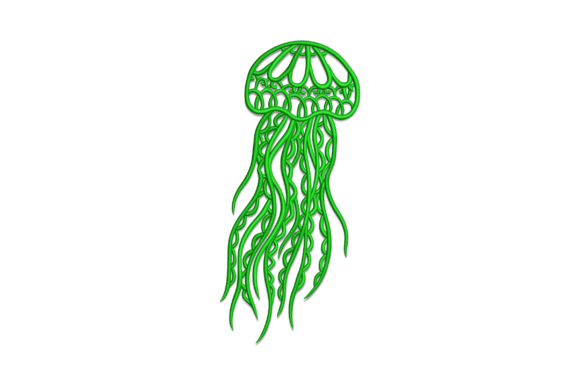
When I opened the Jelly Fish embroidery file on my digitizing software, what struck me first wasn’t just its charm—but its intentionality. This isn’t a generic fish outline with a few wavy tentacles slapped on. It’s a cohesive, balanced machine embroidery design with thoughtful movement: soft curves in the bell, delicate tapering in the tentacles, and subtle layering that suggests depth without overwhelming density. The mood is playful yet refined—ideal for handmade product lines that aim to feel both artisanal and intentional.
Fits Naturally Into Real Projects
I reviewed Jelly Fish before committing to a client order for a set of organic cotton baby blankets and matching kitchen towels. Its scale and flow make it especially effective on medium-to-large fabric surfaces where motion reads clearly—think tote bag design, pillow covers, or nursery decor. On a sweatshirt embroidery test, the tentacles draped beautifully over the shoulder seam without distortion. For custom apparel, it avoids looking “stamped on”; instead, it integrates like part of the garment’s story.
Performance Across Fabric Types & Applications
Jelly Fish holds up well across varied substrates—but with caveats worth noting. On stretchy fabric like jersey knit (for baby onesies or lounge tees), I paired it with a light cutaway stabilizer and reduced top tension slightly. The fill stitch areas in the bell stayed smooth, and the satin stitch edges remained crisp. On dark fabric, thread color contrast became critical—I swapped standard navy for a metallic silver in one test run, and the shimmer elevated the entire finished product.
For caps and curved surfaces, I used a smaller hoop size and adjusted placement to avoid the crown’s deepest curve. The design’s clean outer edge and minimal underlay meant it didn’t pucker or lift at the front panel. As an embroidered patch, Jelly Fish stitched cleanly on twill backing and peeled easily after trimming—no fraying or gapping in the satin-stitched outline.
On textured fabric like terry cloth (kitchen towels, bathrobes), I added a tear-away + wash-away combo stabilizer. The running stitch details in the tentacle tips stayed legible, and the overall stitch density felt moderate—not so dense it would stiffen the towel, but dense enough to hold definition through repeated washing.
Commercial Use Considerations
As a digital embroidery file from Creative Fabrica, Jelly Fish supports small business needs—especially Etsy sellers and craft fair vendors building recognizable brand assets. Its visual appeal translates directly to stronger product photography: the gentle asymmetry invites natural light play, and the organic shape draws the eye without competing with background textures. When used consistently across a line—say, on aprons, tea towels, and baby blankets—it builds subtle brand continuity without needing logos or text.
I’ve found that customers respond more warmly to personalized gifts featuring designs like Jelly Fish. It feels special but not overly precious—perfect for gender-neutral nursery decor or coastal-themed boutique merchandise. In mockups, it scales cleanly down to 3.5” wide for cap fronts and up to 6.25” for tote bags, making it flexible for multiple SKUs without re-digitizing.
Practical Notes Before You Stitch
- Test on scrap fabric first—especially if using lightweight linen, fleece, or performance blends. Tentacle tips are fine; they’ll reveal skipped stitches or tension issues faster than broad fill areas.
- Check thread color contrast early. A pale yellow jellyfish on cream linen reads softly; the same on charcoal requires brighter thread or a white underlay.
- Review stitch density in your embroidery software. While not excessively dense, the bell’s center has layered fills—confirm your machine handles overlapping satin stitches smoothly.
- Confirm hoop size before hooping. The full design fits comfortably in a 5x7 hoop, but if you’re adapting it for smaller items (like a child’s cap), check whether Creative Fabrica offers alternate sizes—or be prepared to resize carefully while preserving stitch integrity.
- Compare light and dark fabric mockups side-by-side. What reads as whimsical on ivory may disappear on navy unless you adjust underlay or add a subtle outline stitch.
- Use proper stabilizer—cutaway for knits, tear-away for stable wovens, and fusible + wash-away for nap-heavy fabrics like terry or velour.
- Inspect small details post-stitch, especially the ends of each tentacle. A stray thread or minor jump stitch can be trimmed easily—but catching it early saves time on batch production.
- Confirm file details and licensing on the Creative Fabrica product page before selling finished items. Licensing terms vary per designer, and clarity here protects your handmade business long-term.
Design Assets That Earn Their Place
Jelly Fish stands out because it works *with* your process—not against it. It doesn’t demand excessive stabilizer, aggressive tension tweaks, or hours of editing to adapt. As a Fish category embroidery file, it avoids cliché while staying instantly recognizable. It supports storytelling: a seaside café’s apron line, a pediatrician’s waiting room pillows, a summer camp’s embroidered patches—all benefit from its quiet confidence.
Most importantly, it elevates the perception of your handmade product. Customers don’t just see stitching—they see care, cohesion, and creative intention. That impression builds trust, encourages repeat orders, and makes your Etsy listings or craft fair booth feel curated rather than crowded.
Final Thought: A Reliable, Expressive Choice
If you're evaluating Jelly Fish for real project use—whether it’s a single personalized gift or a batch of commercial embroidery products—you’re choosing a design that balances personality with practicality. It’s not flashy, but it’s memorable. Not complex, but never simplistic. And in the world of digital embroidery files, that balance is rare—and valuable.