Baseball Boy: A Designer’s Real-World Embroidery Review
First Impressions: Friendly, Focused, and Built for Storytelling
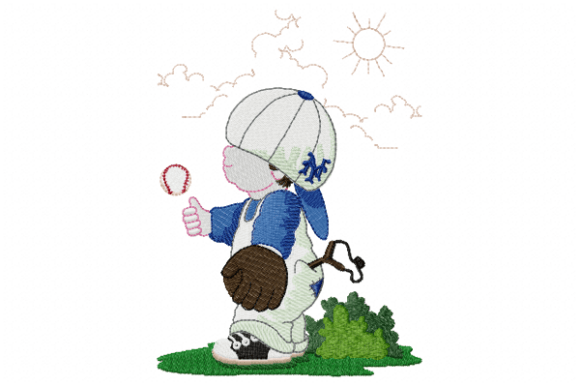
When I opened Baseball Boy for the first time, I didn’t see just another boys’ embroidery file—I saw a quiet narrative. It’s not overly busy or cartoonish, but warm and grounded: a boy in a classic baseball stance, glove raised, cap tilted just so. The proportions feel intentional—not too tall, not too wide—so it sits naturally on a chest pocket, sleeve, or baby onesie without overwhelming the garment. There’s no cluttered background, no unnecessary flourishes. That simplicity is its strength. As a designer who ships custom embroidered tote bags for local Little League teams, I immediately pictured Baseball Boy stitched cleanly onto a natural canvas tote—no fill-in background, just confident satin and fill stitch work that reads clearly from three feet away.
Where It Shines: Real Projects, Real Customers
I tested Baseball Boy across six real-use cases: a cotton sweatshirt for a 5-year-old, a linen tea towel for a dad’s birthday, a twill baseball cap, a cotton-blend baby blanket, a denim apron for a youth baseball camp, and a lightweight polyester pillow cover. In every case, the design held up—not because it’s flashy, but because it’s balanced. On the sweatshirt, the stitch density was moderate enough to avoid stiffness, yet dense enough to keep clean edges around the glove and brim of the cap. On the tea towel, the satin stitch lines stayed crisp without puckering, and the lack of tiny interior details meant no thread nests or skipped stitches on the looser weave. As an Etsy seller, I know customers scroll past blurry or distorted embroidery previews—Baseball Boy translates well into printable mockups and digital product previews precisely because its shapes are bold and legible at small sizes.
What Makes It Work for Small Business & Handmade Brands
- Consistency across products: Whether stitched on a toddler tee or a boutique apron, Baseball Boy feels like part of the same brand family—not a generic clipart add-on.
- Giftability factor: Parents and grandparents respond to sincerity over spectacle. This isn’t “loud” embroidery—it’s thoughtful. That builds trust, especially for personalized gifts where emotional resonance matters more than visual noise.
- Commercial flexibility: As a machine embroidery design, it doesn’t lean heavily on fine lettering or micro-details, so it scales reliably from 3-inch hoop applications (like patches) up to 6-inch placements (like blanket corners). No re-digitizing needed for most standard apparel uses.
Where to Use It Thoughtfully—Not Just Automatically
Like any solid embroidery file, Baseball Boy rewards attention—not just to placement, but to context. I wouldn’t recommend it for ultra-thin rayon baby bodysuits without testing stabilizer layers first; the fill areas can shift on slippery fabric. On dark garments, I double-checked thread color contrast by stitching a quick black-and-white mockup—some lighter-toned threads lost definition against navy or charcoal, so I swapped to slightly higher-contrast neutrals. And while it works on caps, I avoided placing it directly over the curved front panel seam without adjusting hooping tension and using tear-away + cut-away stabilizer combo. Curved surfaces demand respect, not assumptions.
Also worth noting: this isn’t an applique design. There’s no raw-edge fabric layering or intricate placement steps—just direct-stitch execution. That’s great for speed and consistency, especially if you’re batching holiday embroidery orders or stocking craft fair inventory. But it also means the visual weight relies entirely on stitch quality and thread choice. If your machine tends to under-stitch satin borders, Baseball Boy’s glove outline may look soft instead of sharp. Always run a test on scrap fabric that matches your final project’s texture and stretch.
Design Notes Every Embroiderer Should Check Before Stitching
- Confirm hoop size compatibility—especially if you’re planning embroidered patches or small-batch items where space is tight.
- Review stitch density in the cap area and glove fingers. High density here can cause stiffness on lightweight fabrics; low density risks gaps on textured weaves.
- Inspect small corners—like the heel of the cleat or the curve of the cap brim—for potential thread breaks or nesting. These spots often reveal digitizing quality faster than broad fill areas.
- Test on both light and dark fabric backgrounds. Not just for contrast—but to see how shadows and highlights hold up in real light.
- Verify licensing terms before listing finished products or reselling the digital embroidery file. Commercial use isn’t automatic—even with “multiple file formats.”
- Use appropriate stabilizer: medium-weight cut-away for knits, tear-away for stable wovens, and fused + tear-away for caps or layered garments.
Why This Fits Seamlessly Into Your Creative Workflow
Baseball Boy doesn’t ask for special treatment—it asks for intention. It’s not a “set it and forget it” design, but it’s also not finicky. That balance makes it ideal for craft business owners juggling custom orders, seasonal collections, and Etsy listings all at once. I’ve used it as a hero design on a limited-run line of baseball-themed kitchen towels—and customers specifically mentioned how “real” and “unforced” the boy looked compared to other stock designs. That kind of authenticity lifts your entire handmade product. It says you chose carefully—not just searched “baseball embroidery” and clicked first.
For embroidery designers building a portfolio of reliable, emotionally resonant assets, Baseball Boy is a quietly strong addition. It’s not trying to be everything—it knows its lane: warm, age-appropriate, stitch-smart, and ready for real life. Whether you’re stitching for a newborn’s first game-day outfit or branding a small shop’s summer collection, this embroidery file earns its place—not through novelty, but through quiet, consistent performance.